
Want to make wine with me?
A slow project in gathering, waiting, and transformation
Dandelion wine is one way to work with what is already here. Every spring, the fields fill with yellow. Most people see weeds. This is a season offering itself.
This is not a fast recipe. It asks for time and attention. It begins with your hands in the grass, gathering petals. It moves through days of steeping and quiet change. It ends months later, when what began as flowers becomes something entirely new.
This process will be shared step by step on social media as a free, casual shared experience. Daily updates of the winemaking process will be posted with information as it unfolds so you can see each stage in real time.
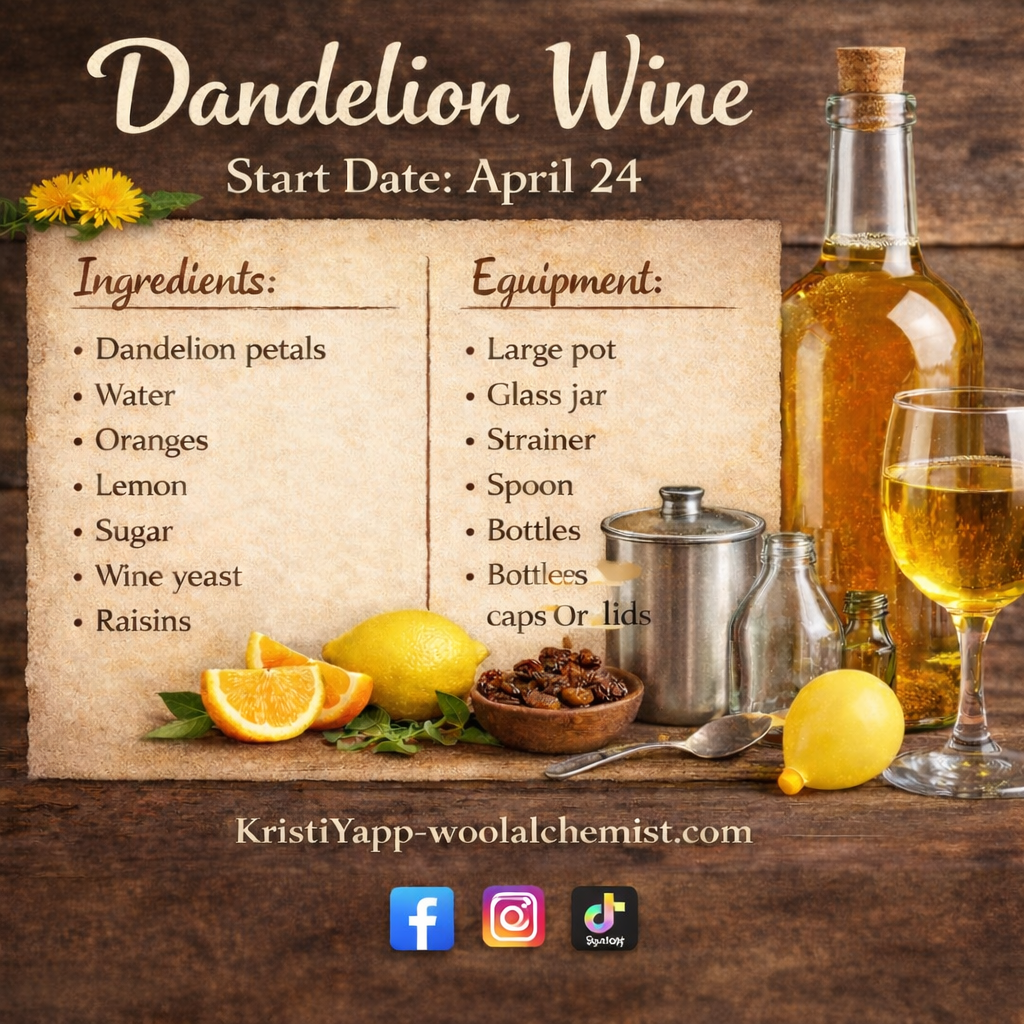
The batch will begin on Friday, April 24.
If you would like to join in, the full recipe is below.
Ingredients
3 quarts yellow dandelion petals
1 gallon water
2 oranges
1 lemon
3 pounds sugar
1 packet wine yeast
1 pound raisins
Equipment
Large pot
Large glass jar or fermentation vessel
Strainer or cheesecloth
Long spoon
Clean bottles with caps or lids
Balloons
Before You Begin
Pick your dandelions on a dry, sunny day when the flowers are fully open.
Use only the yellow petals. The green parts can add bitterness. This step takes time. This is where the process really begins.
Step 1: Make the Dandelion Infusion
Place your petals into a large container.
Bring 1 gallon of water to a boil and pour it over the petals. Cover and let this sit for 3 days.
Stir it once or twice each day. The color will deepen into a rich golden tone.
Step 2: Strain and Build the Base
After 3 days, strain out the petals and keep the liquid.
Slice the oranges and lemon, including the peel. Add them to the liquid along with the sugar.
Stir until the sugar is fully dissolved.
Let the mixture cool to room temperature.
Step 3: Begin Fermentation
Once cooled, add the raisins and the wine yeast.
Cover the container with a cloth and place it somewhere warm.
Within a day or two, small bubbles will begin to form and rise to the surface.
Stir the mixture once a day for about 1 to 2 weeks.
Step 4: Strain and Transfer
When the bubbling slows, strain out the fruit and raisins.
Pour the liquid into a clean fermentation vessel or jar. Secure a balloon over the opening.
Let it sit and continue to develop for several more weeks.
Step 5: Bottle and Age
Once fermentation has settled and the liquid has cleared, pour it into bottles.
Seal with caps or lids and store in a cool, dark place.
Let it age for at least 6 months. The longer it sits, the smoother it becomes.
Notes from the Process
This is a process of gathering, preparing, and allowing something to change over time.
There is a moment when the flowers stop being flowers. There is a moment when the liquid begins to move and shift on its own. That is where the transformation happens.
Follow the Process
Daily updates of this batch will be shared as it unfolds.
You can follow along on Facebook, Instagram, Substack, or TikTok and take part in the process, share your progress, or ask questions as you go.
If you plan to join in, gather your ingredients and begin on Friday, April 24.
