Creeping Charlie
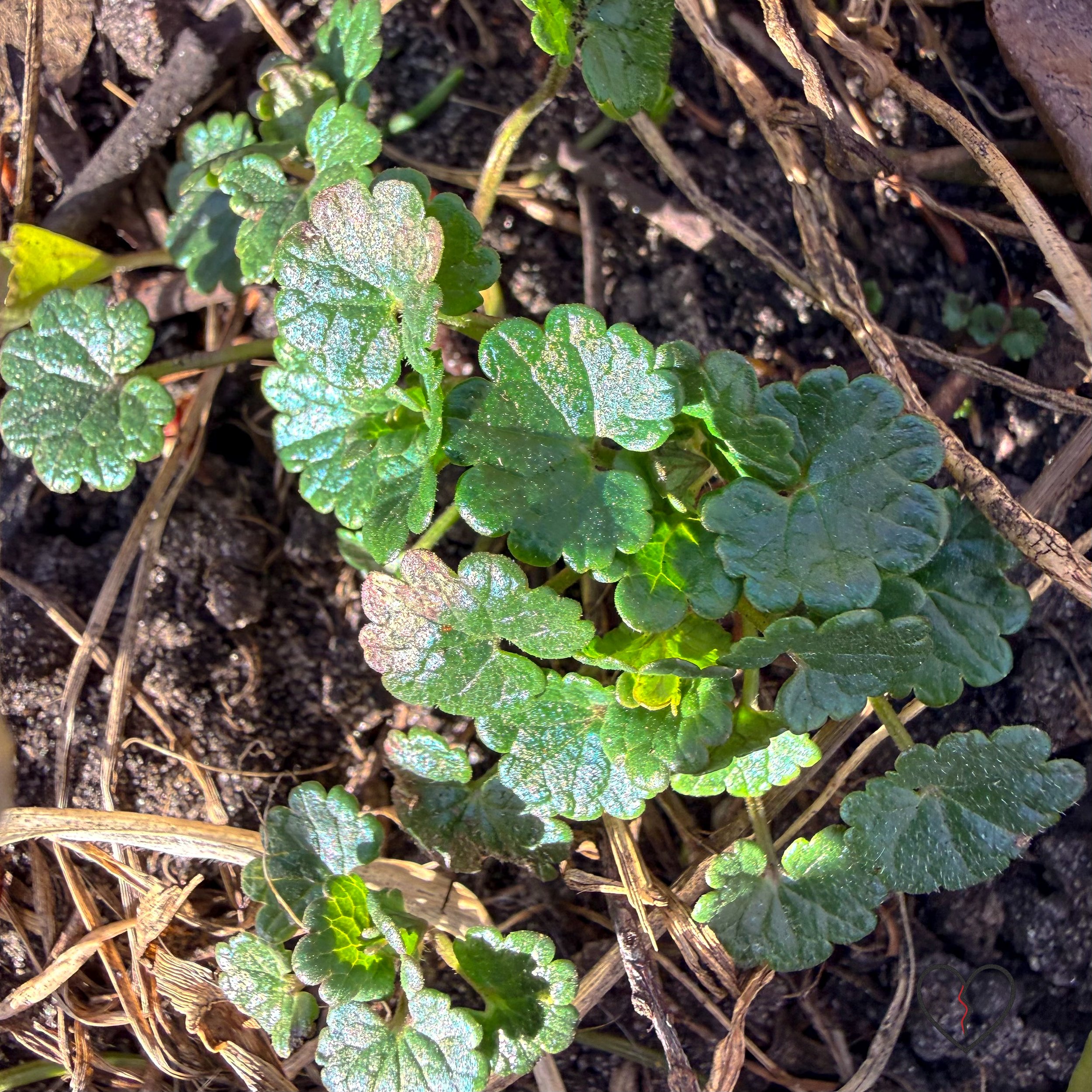
In yards that have not been treated with chemicals, Creeping Charlie shows up early and spreads without hesitation. It moves low across the ground, sending out runners and forming a dense mat of rounded leaves. Many people know it as a nuisance. It is often pulled out, bagged, and thrown away without a second thought.
This is a plant that does not ask for permission to grow. It establishes itself, holds its ground, and returns year after year.
I remember my mom pulling it out of her garden by the armload. No matter how much she cleared, it came back. At the time, it was just something to manage. What she was removing and discarding was a plant with a long history of use.
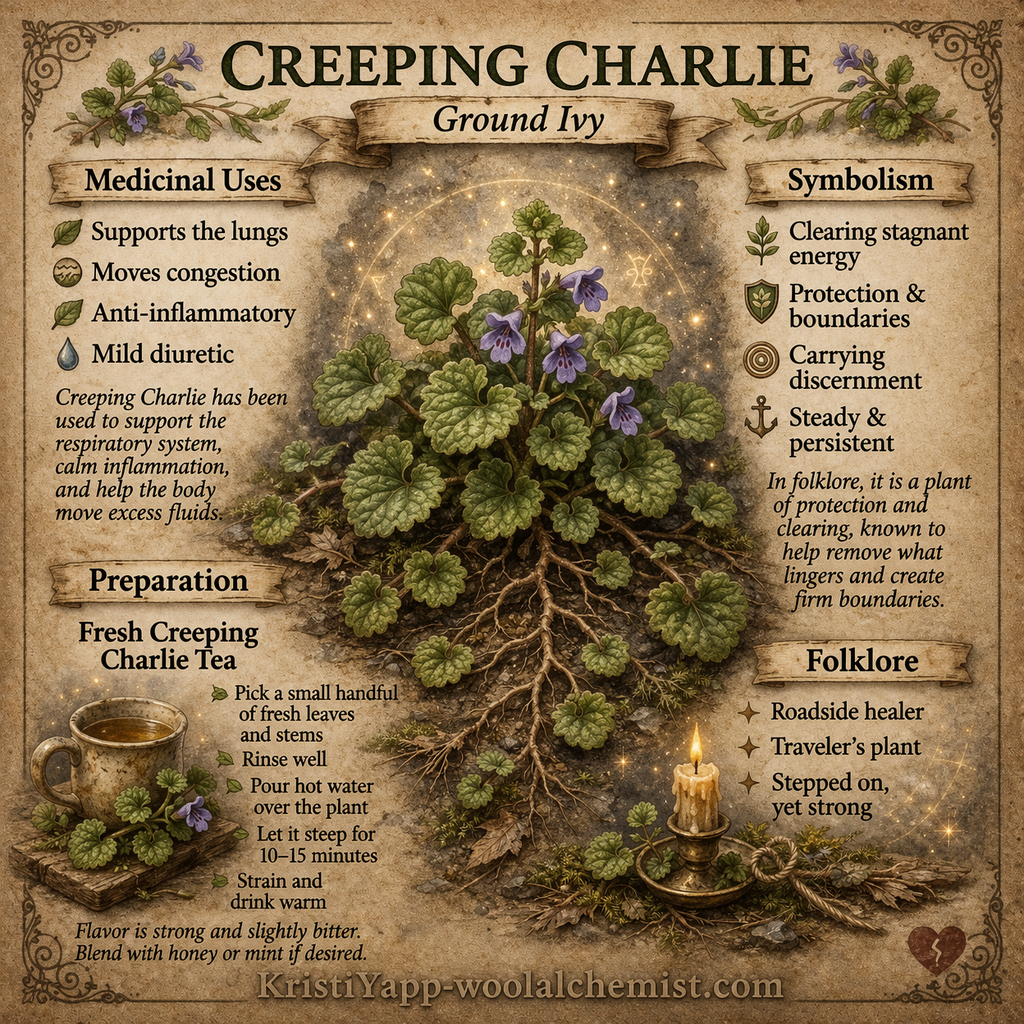
Creeping Charlie, also called Ground Ivy, has been used for generations as a working herb. It is part of the mint family, and like many plants in that family, it carries both strength and function.
Creeping Charlie grows close to the ground and spreads outward rather than upward. The leaves are round with scalloped edges and a slightly textured surface. They grow in pairs along creeping stems that root as they move.
In spring, small purple flowers appear. These flowers are subtle but distinct, tucked close to the plant rather than rising high above it.
This growth pattern tells you something about the plant itself. It covers, it holds, and it persists.
Creeping Charlie has been used to support the body in direct and practical ways.
It is most commonly associated with the respiratory system. The plant helps move congestion and supports the lungs during times of buildup or irritation. It has also been used to calm inflammation and support tissue that has become irritated.
As a mild diuretic, it supports the movement of fluids through the body. This can be helpful when the system feels stagnant or slowed.
The leaves and stems can be dried for tea or used fresh. It can also be infused into oil and worked into salves.
This is not a plant that needs complicated preparation. It works well in simple forms.
Early spring is when Creeping Charlie is at its most accessible. The leaves are fresh and easier to work with before the plant becomes tougher later in the season.
A simple preparation is enough.
Fresh Creeping Charlie Tea
Pick a small handful of fresh leaves and stems
Rinse well
Pour hot water over the plant
Let it steep for 10 to 15 minutes
Strain and drink warm
The flavor is strong and slightly bitter. It can be taken as is or blended with other herbs.
Working with the plant in this way keeps the process direct and grounded.
Creeping Charlie carries a steady kind of energy. It is not a plant that stands tall or demands attention. It works quietly, spreading outward and holding space.
In folklore, it is associated with protection and clearing. It has been used to help remove what lingers and to establish boundaries where they are needed.
Its growth pattern reflects this. It does not rise above everything else. It moves through and around, creating a layer that covers the ground.
It is also tied to discernment. It supports the ability to recognize what should remain and what should be cleared away.
Creeping Charlie is often treated as something to remove. It grows where it is not invited and spreads faster than many people want it to.
Because of this, it is rarely seen for what it offers.
This is a plant that thrives under pressure. It returns after being pulled. It fills in empty space. It continues.
There is something to learn from that.
Creeping Charlie grows at your feet, often unnoticed until it has already taken hold.
It does not need special conditions. It does not need careful tending. It shows up, does its work, and stays.
Once you begin to recognize it, it becomes something different. It is no longer just something to remove. It becomes something you can work with.